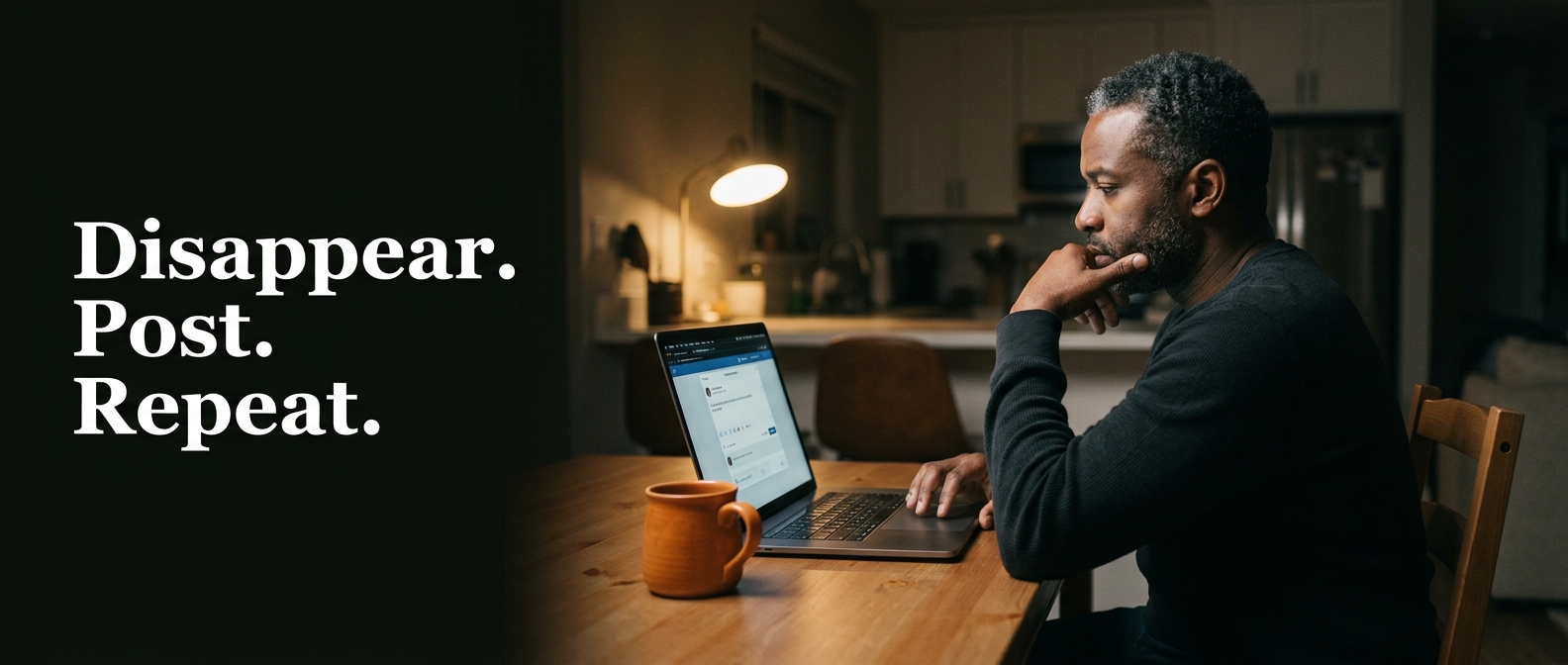

If you disappear from posting for weeks and then post out of guilt, it not be that you have a discipline problem or need another content system.
Posting takes courage, especially when being seen feels risky. After a few posts, going quiet feels like a relief, because nobody can judge a post you didn’t write. But the longer you go without posting, the guiltier you feel. Eventually you post something just to make the guilt go away, and the whole cycle starts over. I call this the visibility cycle.
Key Takeaways
- The visibility cycle is when you post for a while, go quiet for weeks, and then post out of guilt. (What the visibility cycle is)
- Inconsistent posting usually isn’t a discipline problem. You already show discipline every week in your business. (Why it isn’t about discipline)
- A content calendar or scheduler can help you plan posts, but it can’t make being seen feel less risky. (Why a content system doesn’t fix it)
- Going quiet gives you a break from being seen, and a post written to get rid of guilt teaches you that posting feels bad. Both keep the cycle going. (What going quiet does for you and why the guilt post makes it worse)
- Pick a posting schedule you can keep during your worst week, like one post a week, instead of a schedule built for your best week. (How often to post)
What is the visibility cycle?
The visibility cycle is a pattern where you post for a while, go quiet for weeks, and then post out of guilt. You might never have had a name for the pattern, but you’ve probably lived it.
Maybe it’s been three weeks since your last LinkedIn post. Your business is doing fine, and your calendar is full of client work. You’ve opened LinkedIn twice today, and both times you closed the app without posting anything.
You might even have a comeback post sitting in your drafts. It probably starts with an apology, or a joke about how bad you are at social media.
A lot of business owners describe this pattern the same way. They say, “I disappear for weeks, then post out of guilt.” Marketing coaches have started writing about the pattern too, like this post on the stop-start cycle from The Visible CEO.
Most advice explains the visibility cycle in one of two ways. Either you lack discipline, or you’re missing a system. I don’t think either explanation gets at why the cycle keeps happening.
Why isn’t inconsistent posting a discipline problem?
Inconsistent posting usually isn’t a discipline problem, because you already have discipline. You show up for client work every week and you meet your deadlines. If you didn’t have discipline, your business wouldn’t be running.
So if discipline isn’t the problem, something else is deciding when you post.
One clue comes from a survey of 600 entrepreneurs and small business owners by Kajabi. 84% of the people surveyed had moderate to intense feelings of being a fraud, which is often called impostor syndrome. A quarter of them said they were afraid the people important to them would find out they weren’t as capable as they seemed.
The second finding matters a lot for posting. The fear isn’t only about strangers on the internet. The fear is about the people who already know you, like your peers and past clients, seeing your name on a post and judging it.
Trying harder doesn’t change the fear of being judged. Not doing what you know you should do is a pattern I wrote about in the knowing-doing gap, and inconsistent posting is the same pattern showing up in your marketing.
Why doesn’t a content system fix inconsistent posting?
A content system doesn’t fix inconsistent posting because a system was never what was missing. You probably already have a content calendar. You’ve probably tried a scheduling tool. You might even have a folder of half-finished drafts. If a system were the problem, one of those tools would have fixed it.
The newer advice says inconsistent posting is a systems problem, not a discipline problem. The advice tells you to write your posts in batches, build up a backlog, and schedule everything two weeks ahead. These tools are real, and they work. I built content systems like these for clients for years.
But a content system solves a planning problem. A scheduler can take publishing off your plate. A scheduler can’t make being seen feel less risky, and it can’t make you want to be seen.
When being seen feels risky, the drafts don’t get finished and the content calendar stops getting used. When part of you doesn’t want to be seen, that part of you will win over any system you set up.
Having a content system you don’t use tells you something about how you feel about being seen.
What does going quiet do for you?
Going quiet gives you a break from being seen. When being seen feels risky, every post takes a lot out of you, because each time you post, people can judge you, disagree with you, or ignore you. Going quiet for a few weeks is how you recover.
Seen this way, your posting pattern isn’t broken. Your posting pattern is controlling how much people get to see of you, and it’s very good at that job. The cost is that while you’re quiet, the people who could hire you aren’t hearing from you.
A client of mine is a good example. In one of our sessions, she told me about a conflict between two of her employees. The way she handled the conflict was textbook coaching. She didn’t react in the moment, and she thought about what she wanted to happen before she talked to them. She didn’t take sides. Then she asked one question, and that question led one employee to apologize to the other without being told to.
Later in the same session, she told me she couldn’t create content. She said she didn’t feel prepared and didn’t know what she would teach.
She had just described doing the exact thing she said she couldn’t do. She coached two people through a conflict, live and under pressure, with real stakes. In a moment like that, I point out the gap. You just did this. Why do you believe you can’t?
Her skill wasn’t missing. What was missing was permission to let people see it.

Some people call this kind of hesitation the fear of being seen. Others say they don’t like being perceived. The fear of being seen isn’t a disorder, and you don’t need a diagnosis. The fear is a pattern that made sense at some point in your life, usually because you learned that being seen could get you judged. I wrote about how we learn these patterns when we’re young in how the stories we tell ourselves keep us stuck, and about why letting people see you is so hard in why authentic marketing feels so hard.
Why does posting out of guilt make the cycle worse?
Posting out of guilt makes the visibility cycle worse because a post written out of guilt teaches you that posting feels bad.
Think about why you write the guilt post. You’re not writing it to help a client or to share something you believe. You’re writing it to make the guilt go away. As soon as you hit publish, the guilt eases up, and the post has done what you needed it to do. Because the guilt post was only meant to get rid of guilt, one comeback post rarely turns into posting every week.
Over time, you start to connect posting with feeling bad instead of with having something to say.
A post you write to make guilt go away teaches you that posting is something you do when you feel bad.
Coming back also gets harder each time around the cycle. The more weeks go by, the more it feels like your comeback post needs to be a big one. So the draft gets longer, you hold it to a higher standard, and three weeks without posting turns into four.
A lot of advice says to acknowledge the break and get back on schedule. That advice treats the comeback post as the fix. The comeback post is part of what keeps the cycle going.
How often should you post if you keep disappearing?
If you keep disappearing, post on a schedule you can keep during your worst week, not your best week. One post a week that you can keep up, even when things are hard, is better than posting five times a week for a month and then going quiet.
I’ve spent years in marketing, managing millions of dollars in ad spend and building funnels. In my experience, posting more didn’t fix inconsistent posting. What helped was making each post feel like less of a big deal.
Here’s how to set up a posting schedule like that.
- Pick a schedule you can keep in a bad week. Post once a week, on the same day each week. Think of one post a week as your minimum, not a goal you have to beat.
- Remember how many posts you’ll have. One post a week adds up to 52 posts a year. As one article on fear of visibility points out, a single post matters a lot less when it’s one of 52 instead of one of three.
- Publish your post and then close the app. A lot of the anxiety comes from checking likes and comments over and over in the hour after you post. Check tomorrow instead.
- When you come back after a break, just post. Some weeks you will go quiet. When you come back, skip the apology and the announcement, and share the next useful thing you have to say. Your audience cares about what you have to say, not how often you’ve been posting.

A schedule like this doesn’t ask you to feel confident before you post. A schedule like this also doesn’t pretend that posting is comfortable. The schedule makes each post small enough that you don’t need three weeks to recover from it.
When each post feels like less of a risk, posting consistently gets a lot easier.
Frequently Asked Questions
How do I stay consistent on social media?
Stay consistent on social media by picking a posting schedule you can keep during your worst week, which for most people is one post a week. Most posting plans are built around how much you could post when you’re motivated. A schedule built for your worst week is one you can keep up when things get busy or hard.
What is the fear of being seen?
The fear of being seen is feeling uncomfortable about people looking at you, judging you, or rejecting you. For business owners, the fear of being seen often shows up as avoiding posting, staying busy with other work, or disappearing after a few weeks of posting. The fear of being seen isn’t a clinical diagnosis. For most capable people, the fear is a way of protecting themselves, not a sign that they lack skill.
Why do I go quiet online when my business is doing fine?
You can go quiet online even when your business is doing fine, because making money doesn’t make being seen feel less risky. Your clients already trust you, and you work with them in private, where you have more control. Posting is public. Your peers and past clients can see what you post and judge it, and the Kajabi survey found that being found out by the people close to them is exactly what many business owners fear.
Is it bad to apologize for not posting?
You don’t need to apologize for not posting. An apology makes your comeback post about your absence instead of about what you have to say. Apologizing also makes coming back harder next time, because every comeback starts to feel like it needs an explanation. Just share the next useful post.