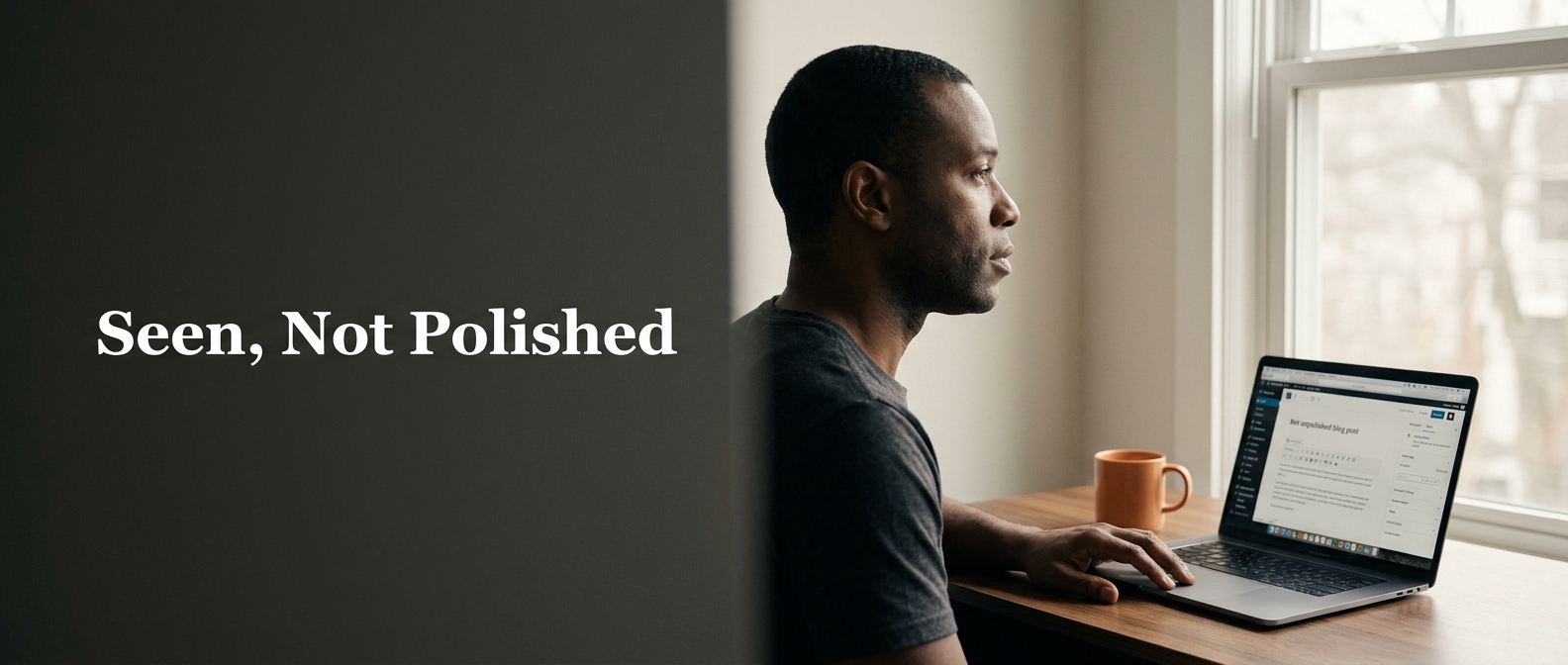

Authentic marketing is hard because it asks you to be seen as yourself, not because you’re missing information. If that feels difficult, it’s usually because you’re not in touch with what you actually want to bring forward and present to the world.
Key takeaways
- “Just be authentic” is advice for an information problem. Yours isn’t an information problem. The how-to is free on YouTube, Google, and every AI chat tool.
- Authentic marketing asks you to be seen, with your real opinions and your real point of view. That’s exposure, not a tactic.
- Inconsistency makes sense. Impostor feelings show up in up to 82% of professionals, and holding back from self-promotion is a documented form of self-protection, not laziness.
- Real marketing problems fail in specific, fixable ways. The problem that survives every course and tactic change is figuring out what you really want to put into the world.
- In 2026, polish reads as fake anyway. The hiding place stopped working.
In this post
- Why doesn’t “just be authentic” work?
- What’s authentic marketing actually asking you to do?
- Why your inconsistent marketing actually makes sense
- Is your marketing problem really a marketing problem?
- What does marketing that doesn’t feel fake actually look like?
- FAQ
Why doesn’t “just be authentic” work?
“Just be authentic” doesn’t work because authentic marketing is just being yourself. If you’re struggling with it, the issue isn’t that you’re missing instructions. It’s that you’re not really in touch with how you want to show up.
Scroll LinkedIn or Instagram for ten minutes and you’ll find the 2026 playbook. Show your face. Use your voice. Tell your stories. Be imperfect, because audiences are tired of AI-generated sameness.
None of it is wrong. That’s what makes it so frustrating.
You’ve read that advice a dozen times, agreed with all of it, and your last post is still three weeks old. Advice can only fix a knowledge gap, and there is no knowledge gap here.
So the question worth asking isn’t “how do I be more authentic?” It’s “why does something this simple feel this hard?”
What’s authentic marketing actually asking you to do?
Authentic marketing asks you to be seen. Not your logo, not your scheduled content, not a polished version of your business. You, with your actual opinions, your actual story, your actual face.
That’s exposure, not a tactic. Which is why it lands differently than every other piece of business advice you’ve taken.
You’ve changed prices, switched niches, and rebuilt your website without much drama. Those moves don’t put you on the line. Showing up as yourself does, because once people can see you, they can judge you, reject you, or ignore you.
Here’s the part I want you to be honest with yourself about. You say you need better marketing. What you usually want is a safer way to be seen.
The polished, templated content was never just a style choice. It was a way to do marketing without ever being seen in it.
Why your inconsistent marketing actually makes sense
Your inconsistent marketing makes sense because it’s exposure management, not a discipline failure. Disappearing for weeks and then posting out of guilt is what it looks like when part of you needs visibility and another part needs protection from it.

The research backs this up. A systematic review of 62 studies covering 14,161 people found impostor feelings in up to 82% of professionals, across men and women at every career stage. Feeling like a fraud when you promote yourself isn’t a defect. It’s close to the default.
There’s also research on professional self-promotion, much of it focused on women, showing that people hold back from promoting themselves because visible self-promotion carries real social penalties. The holding back is rational. It’s protection doing its job.
So the cycle you’re in (post, disappear, feel guilty, post again) isn’t evidence that you’re undisciplined.
It’s evidence that you’ve been asking willpower to override a pattern that’s trying to keep you safe. Willpower loses that fight every time, which is why the next content calendar won’t fix it either.
Is your marketing problem really a marketing problem?
Usually not. Real marketing problems fail in specific, fixable ways. The problem that survives every tactic change and every new course is figuring out what you really want to bring forward and present to the world.
I’m Joseph Bojang, and I say that as someone who spent a decade inside marketing, managing millions in ad spend and building funnels for a living. I’ve worked with a lot of people. With all the free information on YouTube, on Google, and in any AI chat tool, the how is always findable.
So if you’re having trouble doing your marketing, it’s not because you can’t find out how to do the thing you need to do.
Actual marketing problems show up in specific ways. Wrong audience, weak offer, no traffic, a broken funnel step. You can point at them, test them, and fix them, and when you fix them the numbers move.
What you’re dealing with behaves differently. It survived the rebrand. It survived the new content strategy. It survived the course you bought specifically to fix it.
When a problem outlives every tactic you throw at it, the problem was never tactical. I wrote about this pattern in The Knowing-Doing Gap, and marketing is where it shows up the loudest.
What does marketing that doesn’t feel fake actually look like?
Marketing that doesn’t feel fake is marketing you’d be comfortable having your name on. In practice that means three things.
- A claim you believe, about an offer you still want to sell. If you flinch when you write the promise, the problem may not be the marketing. Sometimes the ick is a sign you’ve outgrown the offer itself, which is a different fix. I’ve written about that in The Stories We Tell Ourselves.
- A cadence sized to your real capacity. One honest post a week you can sustain beats a daily schedule that collapses into silence and guilt. Consistency comes from designing around the pattern, not pretending it isn’t there.
- Your actual point of view, instead of borrowed polish. Say what you’ve seen and what you think, in your own words.

There’s also a practical reason to do this now. 80% of marketers use AI for content creation, and audiences have learned to scroll past the output. Instagram’s CEO Adam Mosseri describes the shift bluntly. Polished, professional-looking content used to signal quality. Now it signals the opposite.
So the polished mode that let you market without being seen doesn’t just feel empty. It stopped working.
The only marketing that still works is the kind with a real person behind it. That brings you back to the real question. Not “how do I market myself?” but “what do I actually want to bring forward?”
FAQ
How do I market my business without feeling salesy?
You stop feeling salesy when what you’re saying matches what you believe. Make a claim you’d stand behind in person, about an offer you still want to sell, and the performance feeling drops because there’s no performance.
Is it normal to hate promoting your own business?
Yes. Impostor feelings appear in up to 82% of professionals, and discomfort with self-promotion is one of the most common ways they show up. If promoting your business feels bad, you’re not broken. You’re in the majority.
Do I have to show my face online to grow my business?
No. Plenty of businesses grow through writing, email, and referrals without a single talking-head video. What you can’t outsource is your point of view. The format is negotiable, but somebody real has to be visible in the thinking.
If this named something you recognize, the next step isn’t another marketing course. It’s stepping back far enough to see what you actually want to bring forward. That’s what Step Back to Move Forward is for. It’s free, and it’s where I’d start.
-Joseph