
Feeling stuck is means having a sense that you can’t move forward. It’s when you can’t make a decision, change your situation, or get out of a loop no matter how much you want to.
Sometimes what’s holding you in place is something you can learn or fix. But if you already know what needs to change and you still aren’t doing it, you’re usually dealing with a story problem, not a skill problem.
Key Takeaways
- When you feel stuck, you can get tunnel vision, and most of us respond by trying to learn more. (Why we reach for more knowledge)
- The performance pie shows seven things that affect a result. Knowledge and skill is only one of them. (The performance pie)
- If you don’t know what to change yet, you have a skill problem. If you know what to change and don’t do it, you have a story problem. (Skill problem or story problem)
- For every slice of the performance pie, there are answers you can find. For a story problem, there are no ready-made answers. (Why the pie is only a small part)
- You get unstuck from a story problem by moving forward and becoming someone who can meet the challenge in front of you. (How to get unstuck)
Why do I feel stuck?
You can be stuck in what you think, what you feel, or what you do, and each one makes believe you can’t move forward.
Being stuck can show up in a few ways.
- In your mind. You can’t let go of a thought, like replaying a decision you made two years ago or going back and forth on whether to raise your prices.
- In your emotions. You can’t get over something, like a launch that didn’t sell or a client who left.
- In what you do. You keep repeating the same actions, like opening your laptop to record a video and answering email instead.
Whichever kind it is, once you feel stuck, you want out, and you’ll try almost anything to get unstuck. I learned that in a Jeep.
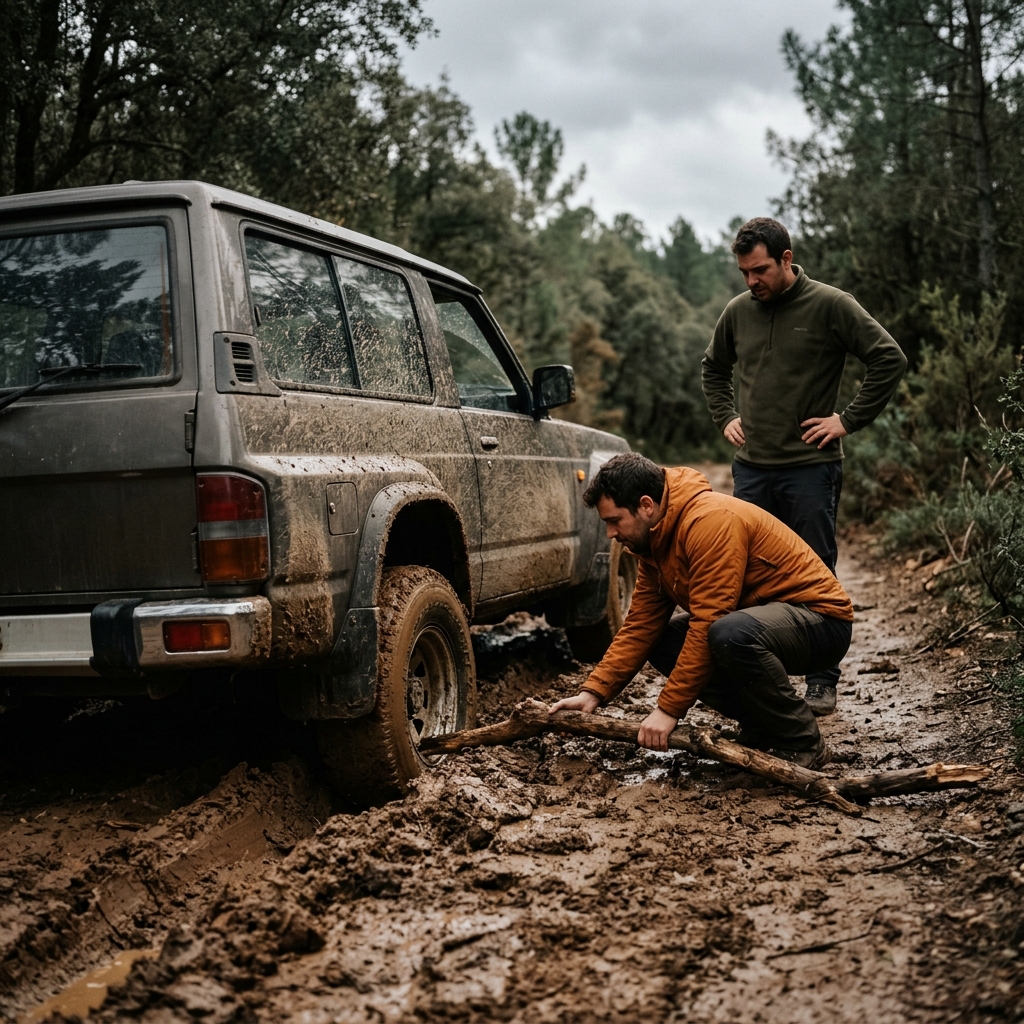
When I owned a Jeep, I went off-roading with some friends, even though I had no idea what I was doing. (I really shouldn’t have gone.)
At one point I got the Jeep stuck in mud, and I didn’t know how to get it out. I didn’t have a winch, and none of my friends had a vehicle that could pull me out. It was just me and a friend acting silly, with no plan.
After about 30 minutes, I was ready to try almost anything. A few people nearby came over to help. They jumped up and down on my bumper to give the tires more traction, and we shoved sticks and rocks under the tires. We were making really bad decisions, one after another.
The whole time, my mind kept running ahead. I pictured the Jeep sitting there overnight and kept wondering how I was going to get it out.
Feeling stuck in life works the same way. We expect to keep making progress, and when we can’t, we feel blocked and start looking for any way out.
Some of the things we try just to get out can cause bigger problems later. If one of the people on my bumper had gotten hurt, or if I had, we would have traded a short-term fix for a long-term problem. When we feel stuck, we tend to grab whatever might get us out right now, even if it hurts us later.
Why do we reach for more knowledge and skill when we’re stuck?
When you feel stuck, you can get tunnel vision. Your attention narrows to the problem right in front of you, and the first fix most of us reach for is learning more.
I wrote about tunnel vision in my guide Step Back, Move Forward. When we’re under pressure, our attention pulls toward the center and we stop noticing what’s around it. We see fewer options, miss signals we’d normally catch, and keep trying to work harder.
For most of the people I work with, working harder means learning more. They sign up for another course, buy another book, or watch another training on the thing they’re stuck on. More information can feel like progress, but it rarely makes the stuck feeling go away.
Other times, tunnel vision pushes us toward reckless fixes, the kind that look a lot like jumping on a bumper in the mud.
Pressure narrows how we see ourselves, too. When the stress builds, we fall back into a familiar role, like the Fixer or the People-Pleaser, and the role comes with its own rules about what we should do. I should be able to handle this. I should have figured this out by now.
If more knowledge isn’t the answer, what else could be keeping you stuck?
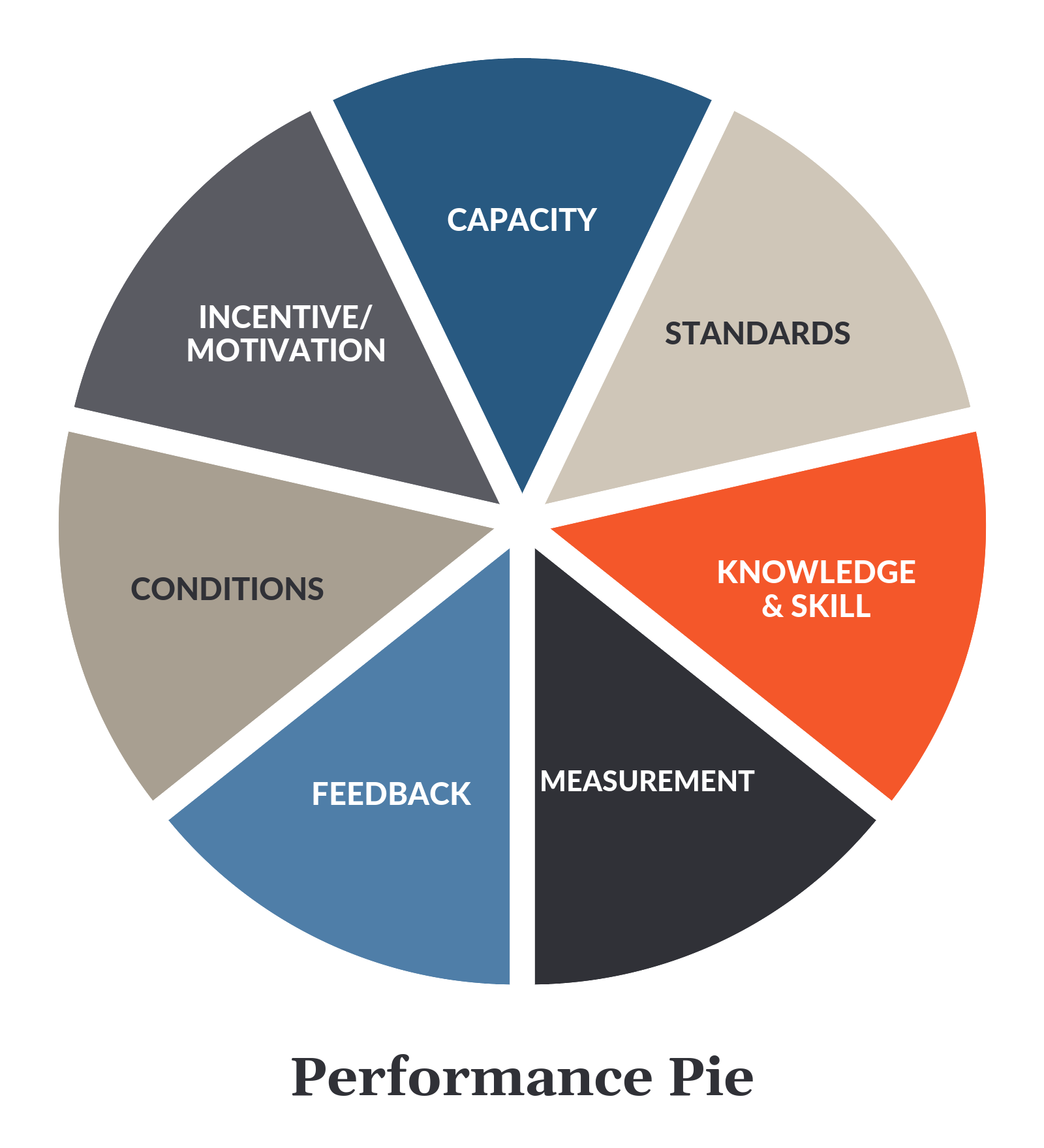
The performance pie is a way to look at things that affect whether you get a result. The seven are capacity, standards, knowledge and skill, measurement, feedback, conditions, and incentive or motivation. Knowledge and skill is only one slice, and it’s the one most of us think of first.
A friend taught me the performance pie, and I use it with people who come to me because a goal isn’t happening or their business isn’t doing what they need it to do.
When people want something, especially a goal like more clients or more revenue, they almost always decide they need to learn more. Sometimes they do. Often the problem is in another slice. Here’s what each slice can look like for a small business owner.
- Capacity. You don’t have the time or energy to take on more work or add another revenue stream.
- Standards. Your work isn’t at the level it needs to be, so fewer people buy from you or refer others to you.
- Knowledge and skill. You’ve never run a sales call or built an email list, so you need to learn how.
- Measurement. You aren’t tracking the numbers that matter, so you can’t tell what’s signal and what’s noise.
- Feedback. Nobody tells you how your offer or your work is landing, so you keep guessing.
- Conditions. Your schedule, tools, or workspace make the work harder than it has to be.
- Incentive or motivation. You don’t charge enough, so another client means more work without more money.
Every area can be improved one step at a time, and every area is worth checking before you decide the problem is you. Some of being stuck really is about skill and capacity. If I had learned how to get a Jeep out of mud, I wouldn’t have needed anyone jumping on my bumper.
How do you tell a skill problem from a story problem?
You have a skill problem when you don’t yet know what needs to change. You have a story problem when you know what needs to change and still don’t do it. In this post, a skill problem covers any slice of the performance pie, not only knowledge and skill.
When people come to me, I can usually help them find the right area to focus. Sometimes I give them feedback. Sometimes we look at their conditions or their pricing.
Most of the time, though, they already know what to do. I’ve worked with a lot of people, and they usually know they need to start their own business, market the business they have consistently, or say no to a demand that no longer fits who they want to be.
Once we’ve named the problem and where to focus, the next question is whether they act on it. When people know what to do and don’t do it, they have a story problem.
Acting on what they know is the one thing I can’t give them. They have to do it themselves.
I wrote more about why knowing what to do doesn’t always lead to doing it in the knowing-doing gap.
Why is the performance pie only a small part of getting unstuck?
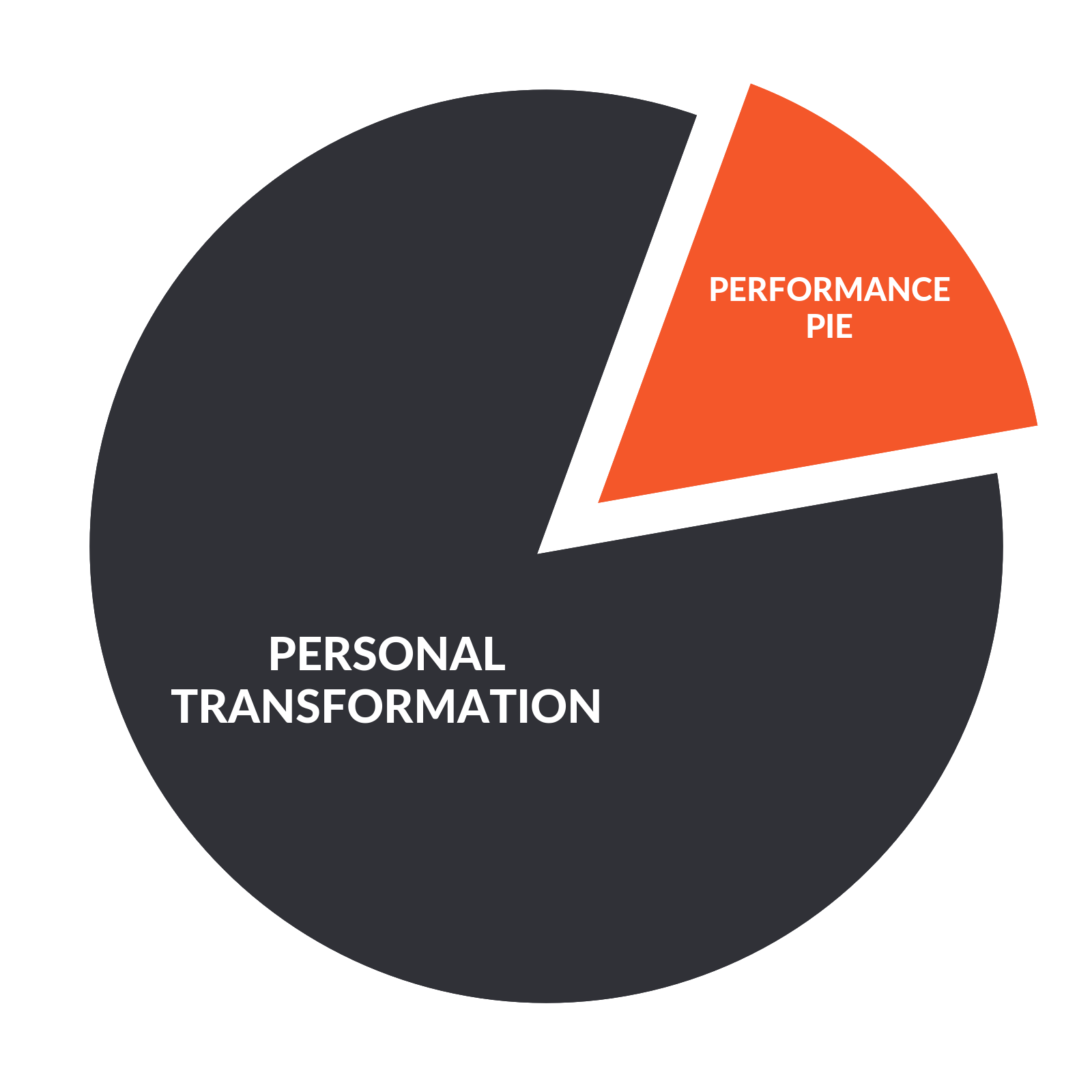
The performance pie is only a small part of getting unstuck because every slice of the pie has answers you can find, and a story problem doesn’t. Once you know what to do, getting yourself to do it takes personal transformation, and personal transformation is most of the work.
If your measurement is off or your prices are too low, there are answers out there. You can look them up, take a course, or ask someone who has solved the same problem.
Ronald Heifetz, a leadership expert, makes the same point about what he calls technical problems. In his essay “Adaptive Work”, he writes that the gap in a technical problem can be closed by applying existing know-how. I wrote more about his distinction in my post on story coaching.
Whenever it comes to a story problem, there are no ready-made answers.
Once you know what needs to be done, you have to get yourself to do it, and you have to be willing to do it badly at first. Your first sales calls will probably be awkward, and your first videos will probably be hard to watch.
When you keep going anyway, you start to notice a story you might be living. It’s the story that doesn’t want you to become someone who chooses differently and shows up differently. Noticing that story and acting anyway is the hard part.
How do you get unstuck in life when it’s a story problem?
You get unstuck from a story problem by growing into someone who can meet the challenge in front of you. Nobody can hand you an answer for that, so you have to move forward without one.
That kind of growth tends to follow a pattern. You leave what you know and go into the unknown. You face the dragons, the things that scare you because they feel like they might eat you. You learn from them, and you find out what you have to surrender so a greater you can emerge.
Moving forward is also how you find out where your story needs to change. When you act, you run into the old story that’s been keeping you stuck. You can’t find that story by thinking about it. You find it by doing the thing your story doesn’t want you to do.
Expect to be bad at it at first. Pressure is where your capacity gets built, so the discomfort is part of how you grow, not proof that you’re doing it wrong.
To start, look at the story you’re living. I lay out steps for seeing it, along with the call, the fall, and what you have to surrender, in how the stories we tell ourselves keep us stuck. From there, look for the belief at the center of your story. If you can’t see the pattern on your own, a story coach can help you notice it.
When you’re willing to move forward without a ready-made answer, you find out where your story needs to change, and you get much better at reaching the goals that matter to you.
Frequently Asked Questions
What should you do when you feel stuck in life?
When you feel stuck in life, start by figuring out whether you’re missing something you can learn or fix, or whether you already know what to do and aren’t doing it. Look at the seven slices of the performance pie, from capacity to incentive. If you find the slice and still don’t act on it, the story you’re living is the next place to look.
Can being stuck be both a skill problem and a story problem?
Yes, being stuck can be both a skill problem and a story problem. Start by finding the slice of the performance pie that needs work and fix what you can. If you know what to do after that and still don’t do it, the story is what’s left.
Why do I feel stuck in my career?
You may feel stuck in your career because you’re missing a skill or the right conditions, or because the story you’ve told about your career no longer fits. The same test works here. If you know what to change and aren’t changing it, look at the story. I wrote about what happens when your career changes and your career story doesn’t hold.
Is feeling stuck a sign of depression?
Feeling stuck isn’t a diagnosis, and it isn’t the same as depression. If low mood, anxiety, or something heavier is part of what you’re dealing with, talk to a licensed therapist. Coaching isn’t a substitute for that.