

Have you ever noticed a conversation going sideways while you’re in it, and you can’t say why?
You were calm when it started, the other person said something normal, but somehow the whole exchange turned sour.
Here’s the reason. Conversations go sideways because even when just two people are talking, four show up. Every conversation is really four conversations happening at once, and the friction is usually in one you’re not aware of.
Key Takeaways
- Every conversation has four participants. Two conscious selves doing the talking, and two unconscious selves each person brings without knowing it.
- Those four participants create four conversations running at the same time. The visible exchange, the projection, your internal dialogue, and the invisible exchange between the two unconscious selves.
- Defensiveness isn’t bad manners. Research shows it spikes when your sense of being a good, capable person feels threatened, and drops when you feel valued.
- The most reliable sign you’ve left the visible conversation is intensity that doesn’t match the content.
- The practice is one question. “Am I reacting to this person, or to my own inner figure standing in front of them?”
Why Did That Conversation Go Sideways So Fast?
A conversation goes sideways fast when the intensity stops matching the words. One minute you’re talking calmly about something ordinary, and the next you’re both defensive, and neither of you can point to what actually changed.

Here’s a scene you’ll recognize, even if the details differ.
Lena calls her brother Marcus on a Sunday afternoon. She mentions she’s finally signing up for the certification program she’s been talking about for a year. Marcus asks, “Have you thought about how you’ll pay for it?”
That’s the whole question. Reasonable words, even tone. But Lena’s chest tightens, her answers get short, and within two minutes she’s saying “why do you always do this” while Marcus insists he was just asking.
If you played back a recording of that call, you wouldn’t find anything wrong with it. Marcus asked a reasonable question in a reasonable tone, and a fight happened anyway.
The Gottman Institute defines defensiveness as self-protection against a perceived attack. That word, perceived, is the whole mystery. Marcus didn’t attack. Lena perceived one anyway.
So where did the attack come from? To answer that, you need to know who was actually on that call.
Who Are The Four People In Every Conversation?
Every conversation has four participants. Each person brings their conscious self, the one doing the talking, and an unconscious self, the one doing the reacting.
Carl Jung mapped this in 1946, in an essay called The Psychology of the Transference. He drew it as a diagram for married couples. I’ve spent enough time with that diagram, in my own life and in coaching, to believe it belongs everywhere, not just in marriage. I call the everyday version The Four Person Convo.
Four participants means the conversation you can hear is only one of the conversations actually happening. There are four:
- The visible exchange. Your conscious self talking to theirs. The words.
- The projection. Your conscious self reacting to your inner image of them, laid over the real person.
- The internal dialogue. Your conscious self in conversation with your own unconscious, while you talk.
- The invisible exchange. Your unconscious self and theirs, relating to each other beneath everything.
I’ll call these levels for short, but hold the word loosely. They aren’t a neat stack. They’re four conversations running at the same time, and you have a different degree of access to each one.
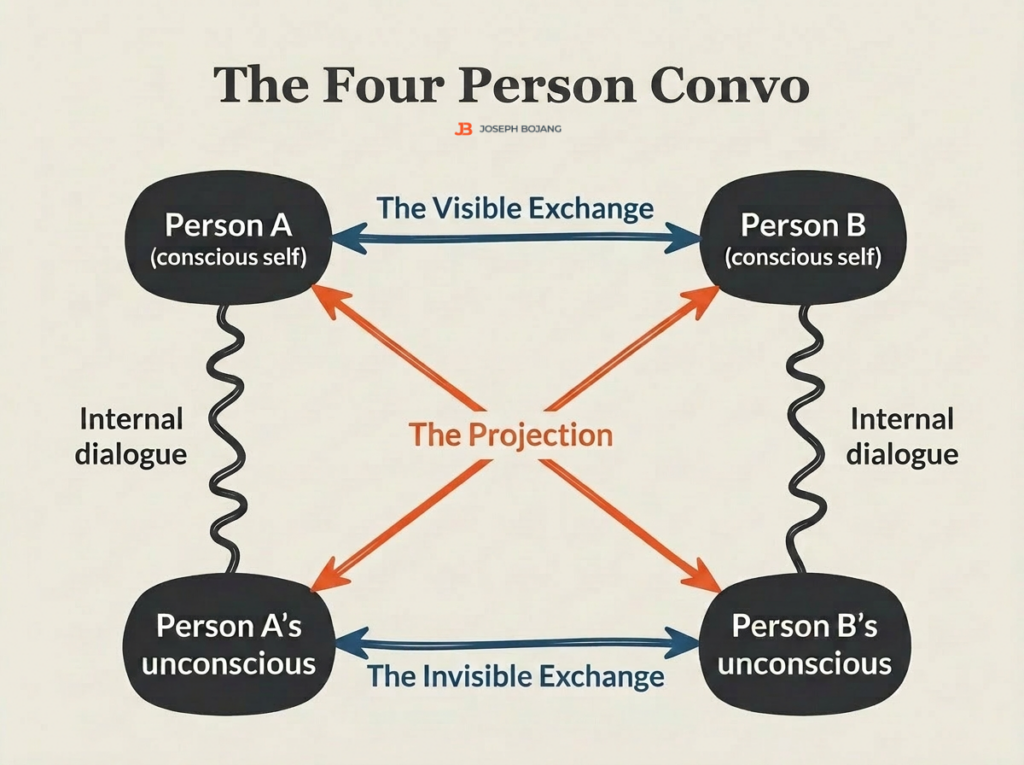
The diagram above is the map for everything that follows. Let’s walk through it with Lena and Marcus, one line at a time.
What Is The Conscious Level Of A Conversation?
The conscious level is the visible exchange. The words, the tone, the facts a transcript would capture. On the diagram, it’s the line running across the top, Person A’s conscious self talking to Person B’s. It’s the only level most communication advice ever addresses.
On the conscious level, the call between Lena and Marcus is short and unremarkable. She shares a plan. He asks a budgeting question. She answers it. If you read the transcript, you’d wonder what either of them could possibly be upset about.
That’s the point. Most advice on how to have better conversations gives you better scripts for this level. Listen more. Use softer openers. Ask follow-up questions.
The scripts aren’t wrong. They just aim at the one conversation that wasn’t the problem. Lena and Marcus didn’t have a wording failure. Something else picked the fight.
What Is The Projection Level?
Projection is reacting to your inner image of someone instead of the person in front of you. The American Psychological Association defines projection as attributing your own characteristics, feelings, and impulses to another person. Everyone does it, in every kind of relationship, and almost nobody catches themselves doing it.
Look at the diagram again. The projection is the pair of diagonal lines crossing in the middle, one running from Person A’s unconscious self to Person B’s conscious self, and the other running the same path in reverse. Your unconscious is reaching across and coloring how you see the person talking to you.
Replay the scene on this level and it looks different.
When Marcus asks about money, Lena doesn’t hear Marcus. She hears her father, who answered every ambition she ever announced with a list of reasons it would fail. That image slides over Marcus’s face like a second photograph printed on the same frame. She responds to the image.
Marcus is projecting too. He’s carrying an old fear about risk that he’s never owned, so he sees recklessness in other people’s plans before he sees the plan. His “simple question” wasn’t as simple as he believes.
This is what it means to argue with someone who isn’t in the room. The projection is unowned by definition. You don’t know you’re doing it, and you usually find out only when someone tells you, which is exactly when most of us get defensive about that, too.
The most reliable signal is disproportion. Couples therapists point out that when the emotional intensity doesn’t match the situation, the reaction is rarely about the present moment. The charge is coming from somewhere older.
What Is The Internal Level?
The internal level is the conversation you’re having with yourself while you talk. On the diagram, it’s the vertical line on each side, running from your unconscious self up to your conscious self. It’s the reaction that arrives before you choose it, the tightening, the heat, the sudden need to explain yourself.
This level can be conscious. You can learn to notice it in real time. Most of us just don’t pay attention to it, because we’re busy managing the visible conversation.
Here’s what research says is happening in there. A Flinders University study published in the British Journal of Social Psychology found that defensiveness isn’t really about the topic on the table. It rises when people feel rejected or seen as a bad group member, and it falls when they feel valued and secure in who they are.
In other words, defensiveness is identity protection. Not rudeness, not immaturity. A person protecting their sense of being good and capable.
Inside Lena, the question “how will you pay for it” lands on a much older question. Am I someone who can be trusted with my own life? Her defensiveness isn’t aimed at Marcus. It’s a wall around that question.
She could notice this. That’s what makes the internal level different from the projection. It’s available to her the moment she turns her attention inward, even mid-sentence.
What Is The Unconscious Level?
The unconscious level is where your unconscious and theirs meet directly. It’s the line running across the very bottom of the diagram, and it’s the current that decides whether you click with someone or clash with them before a word is spoken.

You’ve felt this level even if you’ve never had a name for it. The stranger you trusted instantly. The colleague who rubbed you wrong in the first ten seconds, before they’d done anything. Two unconscious selves met, recognized something in each other, and set the temperature of the relationship while the conscious selves were still saying hello.
Lena’s unconscious and Marcus’s unconscious have a relationship that’s been running since childhood. Her unowned doubt and his unowned fear know each other well. When the siblings talk about anything that touches risk or money, those two unconscious selves start their own exchange, and the conscious conversation gets pulled by it the way a swimmer gets pulled by a current.
Jung’s insight was that this bottom line of the diagram is powerful precisely because it’s invisible. It shapes the visible conversation without asking permission. You can’t watch this level directly. You can only learn to read its effects, the way you read wind by watching trees.
Why Does Communication Really Break Down?
Communication breaks down because we troubleshoot the conscious level while the problem lives on one of the other three. We sharpen the words, manage the tone, rehearse the script, and the same fight keeps happening, because the fight was never in the words.
This explains the experiences that feel like they have no answer:
- The argument about nothing. The content was trivial because the content was never the conversation. Two projections were fighting.
- The person you can’t seem to get along with, despite both of you being reasonable. The clash is on the unconscious level, upstream of anyone’s behavior.
- Knowing you’re overreacting and doing it anyway. Your internal dialogue is protecting your identity, and the Flinders research shows that pressure and shame make that protection stronger, not weaker.
The same study found that defensiveness creates blind spots. Problems go unrecognized and relationships deteriorate, not because people lack information, but because the protection is running.
I see the same structure in coaching. When a capable person keeps reacting in ways they can’t explain, in a client call, a negotiation, a marriage, the answer is almost never a better script. We have to find which conversation the reaction is actually in. That’s the difference between working the pattern and rehearsing the words, and it’s why this model sits underneath how I coach.
There’s a bigger reason this matters than smoother conversations. In your work and your relationships, the hardest thing is often just to be more of yourself. You can’t do that while you’re unknowingly performing for a projection, or while someone else’s projection is telling you who you are. Seeing the four conversations is what gives you the choice.
How Do You Use This In Your Next Conversation?
When you feel the charge rise, ask yourself, “Am I reacting to this person, or to my own inner figure standing in front of them?”
You don’t need to analyze your childhood mid-meeting. You just need to notice which conversation you’re in.
A few things follow from it:
- If the intensity doesn’t match the content, name the level. Not out loud, necessarily…just to yourself. “This charge is older than this conversation.”
- Take back your side first. The antidote to defensiveness is taking responsibility for your part, and your part includes your projection. Lena saying “I think I heard my father just now, ask me again” changes the entire call.
- When someone projects onto you, don’t argue with the image. You can’t win a debate with a figure from someone else’s past. Stay yourself, respond to what was actually said, and let the projection pass through.
What changes over time is bigger than fewer arguments. You start to tell the difference between someone talking to you and someone talking to their image of you. You stop auditioning for projections. You show up as yourself, at work, at home, with strangers, and the people who are actually talking to you get the real person back.
Think of one relationship in your life that feels charged right now. Which of the four conversations is the charge really in?
Frequently Asked Questions
Why am I so defensive in conversations?
You get defensive in conversations because your sense of being a good, capable person feels threatened, not because you can’t handle feedback. Research from Flinders University found defensiveness rises when people feel rejected or stigmatized and falls when they feel valued. The defensiveness is a wall around your identity, which is why it fires even when you know the other person has a point.
What does it mean when someone projects onto you?
When someone projects onto you, they’re reacting to an inner image from their own life that they’ve laid over you, not to anything you actually did. You’ll recognize it because their reaction doesn’t match what you said, or they describe a version of you that you don’t recognize. Don’t argue with the image. Respond to the real conversation and let the rest belong to them.
Is it normal to argue with someone about nothing?
Yes, arguing about nothing is normal, because the argument usually isn’t in the words at all. When two people fight over something trivial, the real exchange is between projections or older patterns underneath the conversation. The content is just the stage the fight borrowed.
How do I stop being defensive?
You stop being defensive by catching the reaction early and taking responsibility for your side of it, including the part where you may be reacting to an old image instead of the present person. The Gottman Institute’s antidote is owning your piece of the issue, even a small piece. Pair that with one question, “am I reacting to this person or to my inner figure,” and the defensiveness loses most of its fuel.
If this was helpful, the next step is learning to catch your own patterns while they’re running. That’s what my free guide, Step Back to Move Forward, walks you through. One honest hour a week, not another system to maintain.
You might also recognize this structure in the gap between knowing what to do and doing it, or in the feeling of not knowing what you actually want. Same territory, different doors.