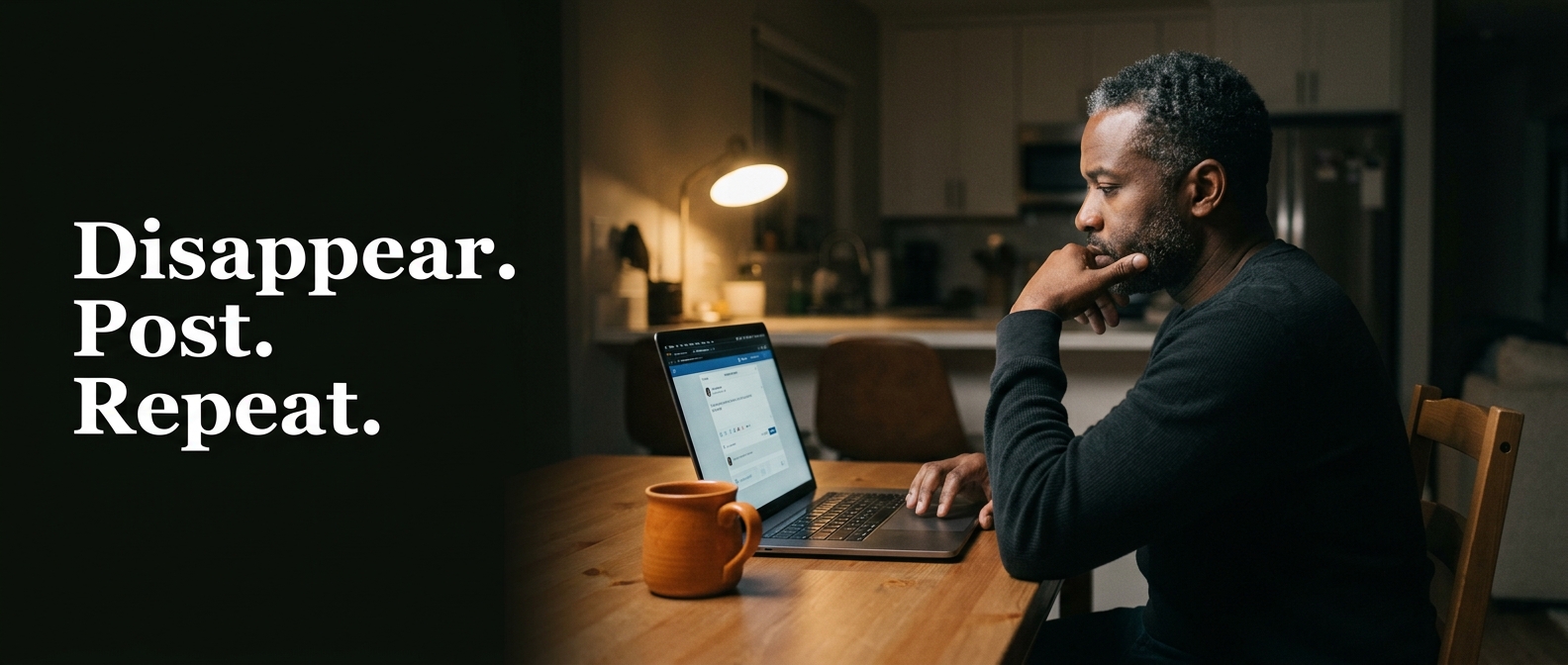

If you disappear for weeks and then post out of guilt, you’re not failing at discipline and you don’t need another content system. The visibility cycle is exposure regulation. Each post spends courage, the silence afterward is how you recover, and the guilt post is what starts the loop again.
Key Takeaways
- The visibility cycle is the loop where you post for a stretch, go dark for weeks, feel worse as the silence runs, then post something out of guilt to break it.
- It isn’t a discipline problem. You already run a business on deadlines. The discipline is fine.
- It isn’t a systems problem either. You own the calendar and the scheduler. A system can schedule the work, but it can’t make being seen cost less.
- The guilt post is the engine of the cycle, not the cure. Posting to discharge guilt teaches you that visibility feels bad, which buys a longer silence next round.
- The fix is a cadence with a floor set at your worst week, not a plan built for your best one.
What is the visibility cycle?
The visibility cycle is the pattern where you post consistently for a stretch, disappear for weeks, feel guiltier the longer the silence runs, and finally post something to make the guilt stop. The comeback post buys relief, not momentum, so the loop runs again.
You probably know your version of it. Three weeks since your last LinkedIn post. The business is fine, the client calendar is full, and you’ve opened the app twice today without posting anything.
Somewhere in your drafts is the comeback post. It has an apology in it, or a joke about being bad at social media.
Business owners describe this loop almost word for word. “I disappear for weeks, then post out of guilt.” Even the marketing space has started naming it, like the stop-start cycle described by The Visible CEO.
Most advice then files it under one of two headings. You lack discipline, or you lack a system. Both miss what the cycle is actually doing.
Why isn’t inconsistent posting a discipline problem?
Inconsistent posting isn’t a discipline problem because you’re already disciplined. You deliver client work on deadline every week. You’ve run a business for years. If discipline were the missing piece, the same discipline that runs your business would run your content.
So the willpower story doesn’t survive contact with your own evidence. Something else is deciding when you post, and it isn’t your calendar.
Here’s a clue about what that something is. When Kajabi surveyed 600 entrepreneurs and small business owners using the Clance impostor scale, 84% scored at moderate to intense levels of feeling like a fraud. A quarter said they feared the people important to them would find out they’re not as capable as they seem.
Read that second number again. The fear isn’t about strangers. It’s about the people who already know you, the peers and past clients who will see the post with your name on it.
That’s not a character flaw you fix by trying harder. It’s the same pattern as knowing what to do and not doing it, playing out in the most public part of your business.
Isn’t it just a missing content system, then?
No, and you can test this claim against your own toolkit. You already own a content calendar. You’ve tried a scheduler. There’s probably a half-finished batch of drafts in a folder somewhere. If a system were the missing piece, one of those would have worked.
The current version of the advice says inconsistency is a systems failure, not a discipline failure. Batch your content, build a buffer, schedule two weeks ahead. The tools are real. I built systems like that for clients for over a decade, and they work for the problem they solve.
But they solve a logistics problem. A scheduler can take publishing off your plate. It cannot make being seen cost less, and it cannot want visibility on your behalf.
That’s why the batch never gets finished and the calendar goes stale. A system run by someone who doesn’t want to be seen will always lose to the part of them that doesn’t want to be seen.
When you don’t use a system you already own, that’s not a gap in your stack. That’s information.
What is the silence actually doing for you?
The silence is doing a job. It’s how you recover from being seen. Every post is a small act of exposure, and if being seen feels like a risk, each one spends something. The weeks of quiet are the budget balancing itself.
That’s what exposure regulation means in plain words. Your posting pattern isn’t broken. It’s managing how much of you the world gets, and it’s doing that job very well. The cost is that your business stays invisible while it works.
A client of mine once spent a session describing a crisis between two of her employees. She handled it with textbook skill. She didn’t react, she prepared her intentions, she stayed neutral, and she asked one question that led one employee to apologize to the other without being told to.
In the same session, she told me she couldn’t create content because she lacked preparation and didn’t know enough to teach.
She had just done, live and under pressure, the exact thing she said she couldn’t do on camera. The competence wasn’t missing. The permission was.

That’s the visibility cycle underneath. Some people call it the fear of being seen, or say they don’t like being perceived. It isn’t a disorder and you don’t need a diagnosis. It’s a pattern that made sense at some point, usually built on a story about what happens when people really look at you, and it’s a story you’ve likely outgrown.
Why does the guilt post make the cycle worse?
The guilt post makes the visibility cycle worse because posting to discharge guilt teaches you that showing up feels bad. The post goes out, the relief lands, and the lesson your pattern learns is that visibility is something you do to stop feeling guilty, not to say something. That makes the next silence easier to enter and longer to leave.
Look at what the guilt post is actually for. It isn’t written to reach a client or share a point of view. It’s written to make a feeling stop. The moment it’s published, its job is done, which is why one comeback post so rarely becomes a streak.
Each lap of the loop also raises the price of re-entry. The longer the silence, the bigger the comeback feels like it needs to be, so the draft gets heavier and the bar gets higher and the silence stretches to week four.
Standard advice says to address the break and get back on schedule. That treats the comeback post as the fix. It’s not the fix. It’s the engine, and every guilty re-entry fuels the next disappearance.
What does a posting cadence built for this pattern look like?
A posting cadence built for the visibility cycle sets the floor at your worst week, not your best. One post a week that you can publish even in a bad stretch beats a five-a-week sprint that ends in a month of silence.
I say this as someone who spent eleven years on the execution side of marketing, managing millions in ad spend and building funnels for businesses like yours. The cadence problem was never solved by more output. It was solved by lowering the cost of any single post.
Here’s the shape of it:
- Pick a floor you can hold on a bad week. One post, same day each week. Not a target to beat. A floor to stand on.
- Let the math shrink the stakes. One post a week is 52 a year. As Kaido’s piece on visibility fear puts it, the stakes of any single post drop when it’s one of fifty instead of one of three.
- Publish, then close the tab. The spiral lives in the hour of refreshing afterward. Check tomorrow.
- Re-enter without ceremony. When you do go dark, and some weeks you will, come back with the next useful post. No apology, no joke about being bad at this, no announcement. Your audience cares about what you said, not your attendance record.
Notice what this cadence is not doing. It’s not asking you to feel confident first, and it’s not pretending the discomfort isn’t there. It’s making each act of being seen small enough that the recovery doesn’t need three weeks.
Consistency stops being the goal you fail at. It becomes the byproduct of a cost you can finally afford.

Frequently Asked Questions
How do I stay consistent on social media?
Stay consistent by setting a posting floor you can hold in your worst week, usually one post a week, rather than a frequency goal built for your most motivated week. Most inconsistency comes from plans that assume your best energy. A floor cadence assumes your worst, which is why it survives the weeks that used to break the streak.
What is the fear of being seen?
The fear of being seen is the discomfort of being looked at, evaluated, and possibly judged, and for business owners it shows up as avoiding posting, hiding behind busywork, and disappearing after stretches of visibility. It isn’t a clinical diagnosis. For capable people it’s usually a pattern of self-protection, not a lack of confidence in their actual skills.
Why do I go quiet online even though my business is doing fine?
You go quiet because revenue doesn’t lower the cost of being seen. A full calendar means people already trust you in private, where you control the room. Posting is public, and it invites judgment from peers and past clients, which is exactly the audience the impostor research says capable owners fear most. The business being fine was never the variable.
Is it bad to apologize for not posting?
Skip the apology. An apology frames your return around your absence and teaches your audience, and you, to track the gaps instead of the ideas. It also makes re-entry more expensive next time, because every comeback now requires a small confession. Just publish the next useful post as if you never left.
Most people in this cycle reach for a new content strategy next. If this post named something you recognize, the better next step is figuring out what the silence has been protecting. That’s what Step Back to Move Forward is for. It’s a short, free guide to looking at the pattern before you force another comeback.
-Joseph